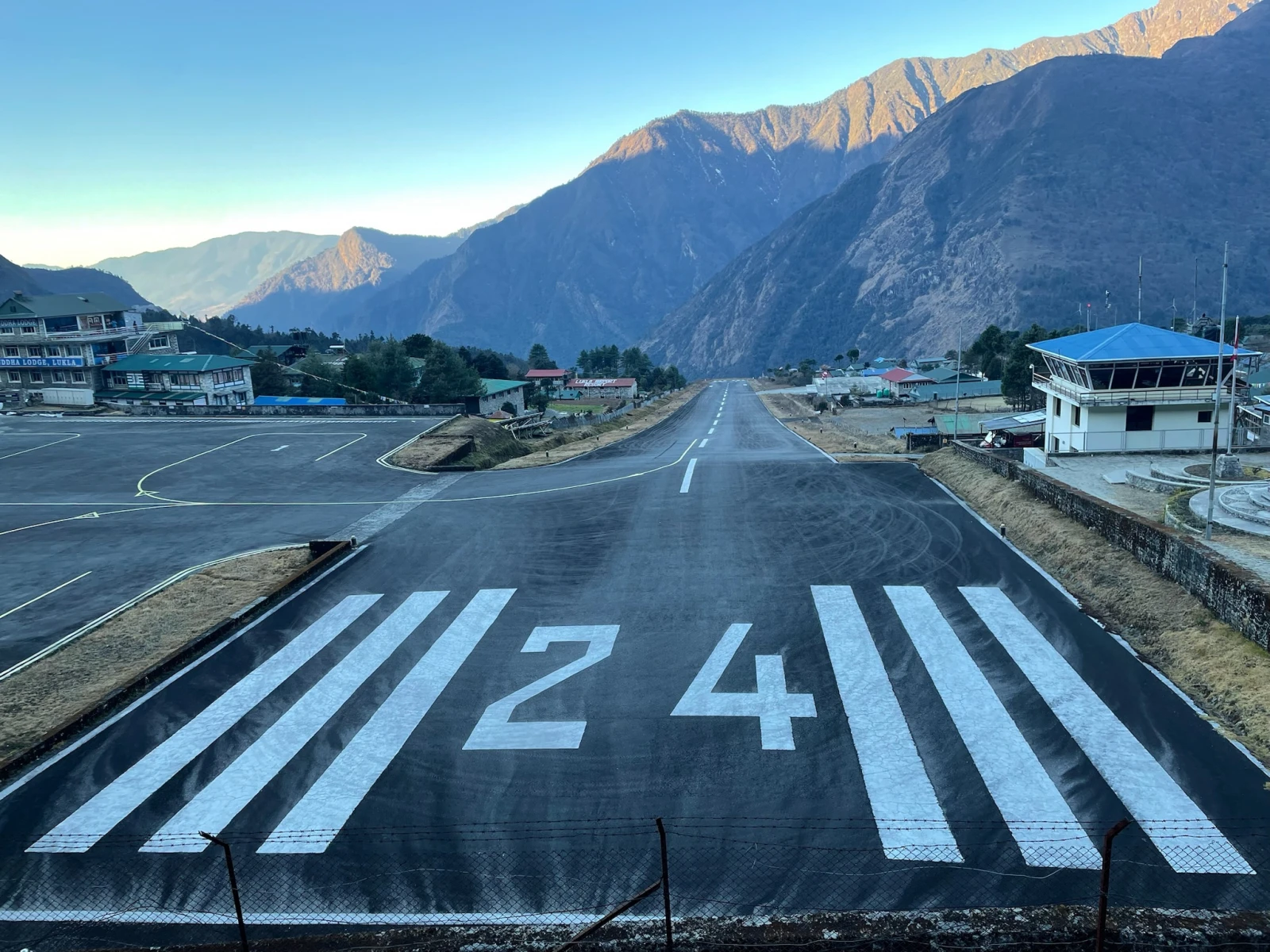
The flight to Lukla is one of the most memorable parts of an Everest trek: a small plane, a wall of mountains outside the window, and a short, sloping runway at the end. It is also the part of the trip that is least in anyone's control. This guide explains where the flights leave from, why delays happen, what you can take, and how we handle it when the weather says no.
Lukla flights at a glance
| Lukla altitude | About 2,850 m |
| Main seasons (March–May, September–November) | Usually from Manthali (Ramechhap): about 5 hours by road from Kathmandu, then about 20 minutes in the air |
| Other months | Usually direct from Kathmandu: about 40 minutes |
| Flight times | Mostly early morning, when visibility is best |
| Baggage | Small planes have a strict weight limit, usually around 15 kg in total including hand luggage. Check your ticket |
| On our EBC trek | Domestic flights and the transfer to Manthali are included in the price |
Manthali or Kathmandu: why two airports?
For years all Lukla flights left from Kathmandu's Tribhuvan airport. To ease congestion there in the busy seasons, most Lukla flights in spring and autumn now leave from Manthali airport in Ramechhap, south-east of Kathmandu. For you, this means a very early start: on our itinerary the pick-up from your Kathmandu hotel is around 12:30 a.m., for a drive of about five hours to reach Manthali in time for the first flights. The flight from Manthali to Lukla is short, about 20 minutes.
In the quieter months (December–February and June–August) flights usually go direct from Kathmandu again, taking about 40 minutes. Which airport you use is decided by the airlines and the authorities for each season, not by the trekking company, and it can change at short notice.
Why Lukla flights get delayed
Pilots fly to Lukla by sight. They need clear weather at the departure airport, along the route and at Lukla itself, and cloud in the valleys often builds by late morning. Delays and cancellations are part of every season. They are most common in the monsoon (June–August) and on cloudy days in winter, but they also happen in October and April. A delay can mean a few hours' wait at the airport, or a full day.
The same applies on the way back. Flights out of Lukla are just as weather-dependent, which is why we recommend at least one spare day between the end of your trek and your international flight home.
What happens if your flight is delayed or cancelled
- We rebook you on the next available flight.
- If you are short of time, a shared helicopter between Lukla and Kathmandu is possible at extra cost. Our current estimate is around US$350 per person when shared with four others, depending on the season and availability.
- Extra nights and costs caused by weather are not included in the trek price. This is another reason to keep a spare day, and to have travel insurance that covers trip delays.
Baggage: what to take on the plane
The planes are small, and the airline weight limit is strict, usually around 15 kg in total including your hand luggage. Excess baggage is charged per kilo, if there is space for it at all. On our trek, one porter carries for two trekkers, up to 10 kg per person, so packing light helps in the air and on the trail.
- In your hand luggage: a warm layer, water, snacks, sunglasses, valuables, medicines and your permits and passport copies.
- In the checked bag: everything else for the trek.
- Leave behind: clothes for after the trek and anything you won't need in the mountains. You can store them at your hotel or at our office in Kathmandu.
Tips for a smoother Lukla flight
- Plan one or two spare days at the end of your trip.
- Expect early starts and some waiting. Bring a book and a power bank.
- Wear warm layers: Lukla can be cold when you land, even after a mild morning in Kathmandu.
- Take it easy on your first day. Even at 2,850 m, walking slowly from the start helps your acclimatisation.
Ready to go? See our 14-day Everest Base Camp Trek, the EBC difficulty and training guide, or compare every option, including helicopter returns, on our Everest region page.