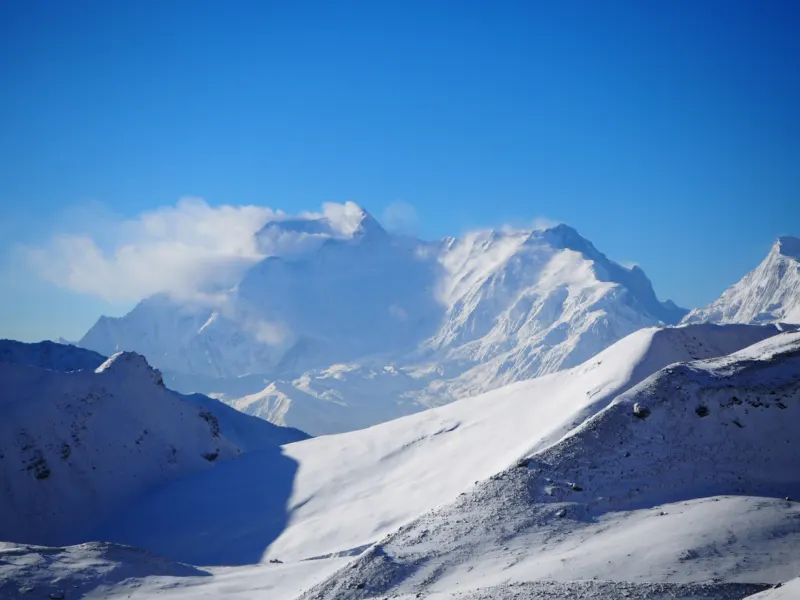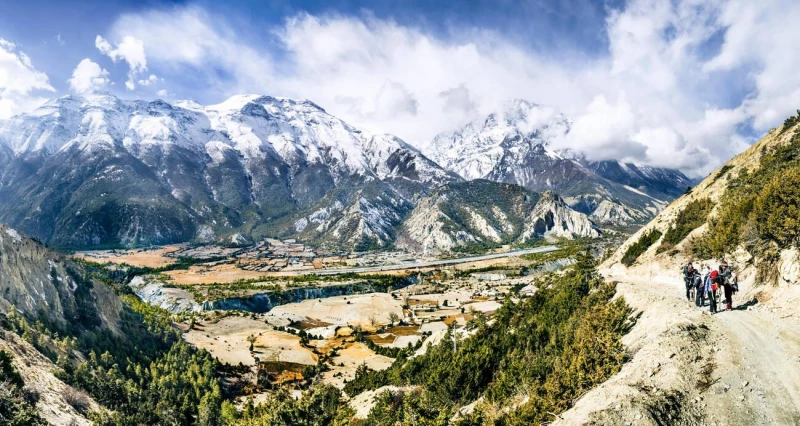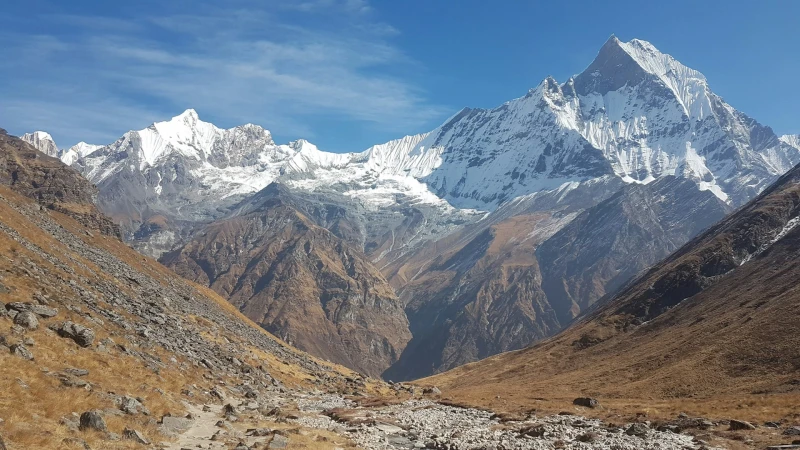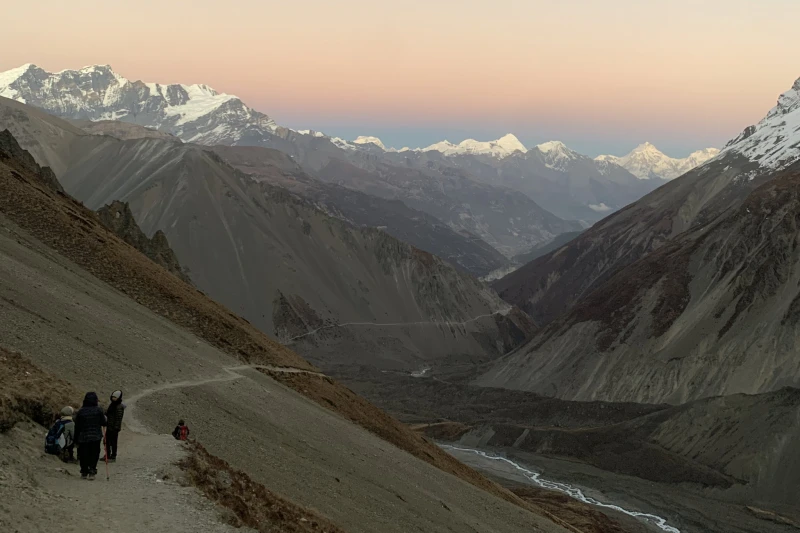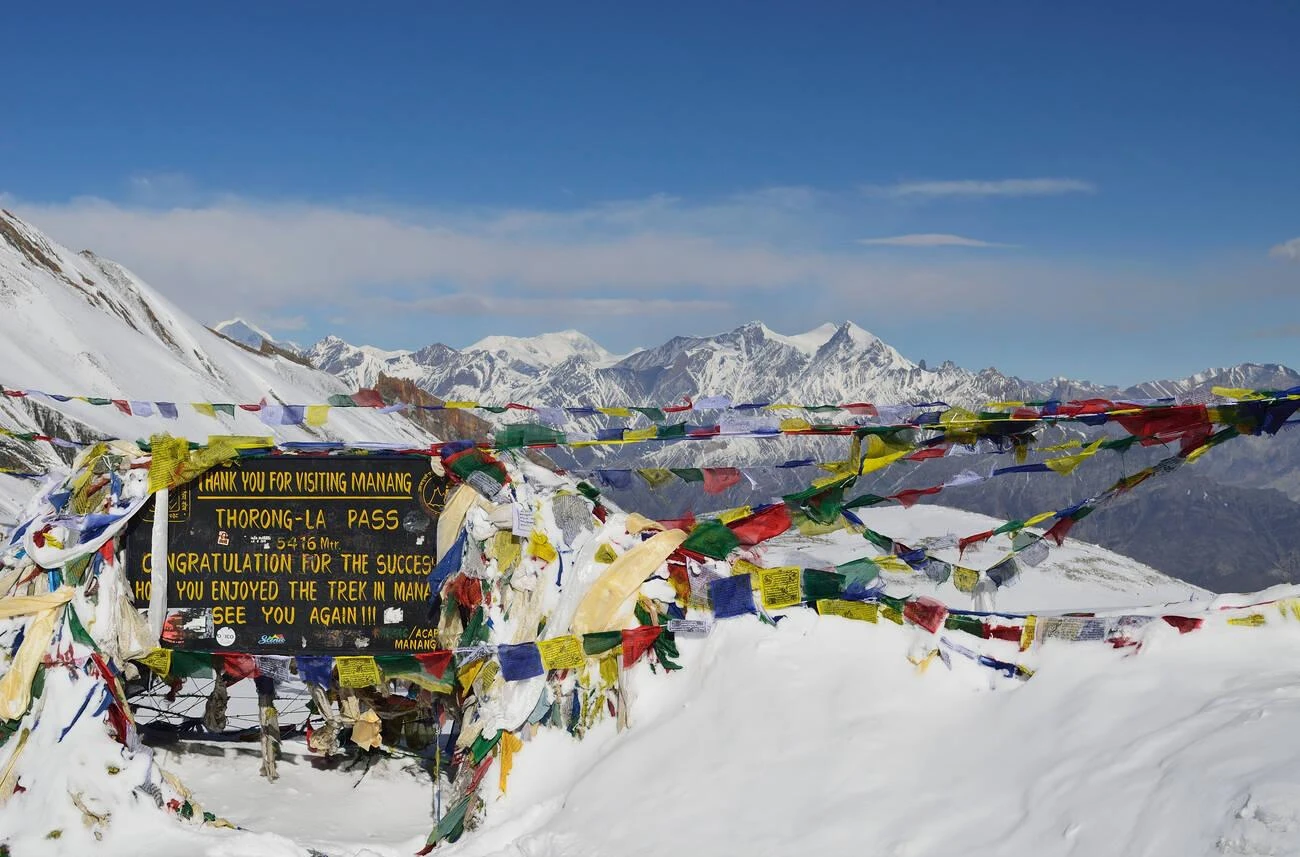
Ask anyone who has walked the Annapurna Circuit which day they remember most, and the answer is almost always the same: Thorong La. It is the highest point of the trek, the place where the Marsyangdi valley of Manang meets the Kali Gandaki side of Mustang, and the one day of the Circuit that can go wrong if it is rushed. Most pass days go smoothly. The ones that don't usually start with a decision made the evening before. This guide explains how the day works and what a careful guide looks at before saying "we go".
Thorong La at a glance
| Height of the pass | 5,416 m (17,769 ft) |
| Start points | Thorung Phedi 4,525 m, or High Camp 4,925 m |
| Climb to the top | About 890 m from Thorung Phedi, about 490 m from High Camp |
| Descent to Muktinath | About 1,650 m, down to 3,760 m |
| Time on foot | Around 9 hours or more, door to door |
| On our 14-day Circuit | Day 10, after an acclimatisation day in Manang (3,540 m) and a night in Ledar (4,200 m) |
| Best months | March–May and September–November. Snow can close it in December–February. |
Thorung Phedi or High Camp?
The last night before the pass is either at Thorung Phedi (4,525 m) or about an hour's steep climb higher at High Camp (4,925 m). Each has a trade-off:
- Thorung Phedi: you sleep 400 m lower, which usually means better sleep and less headache. The price is a longer, harder pass morning, with the steep climb to High Camp done in the dark and the cold.
- High Camp: a shorter pass day and a head start on the wind. But it is a cold, basic place to spend a night at almost 4,900 m, and anyone who is struggling with the altitude will feel it there first.
A sensible guide decides on the day, not months before. If the group arrives at Phedi strong and well, going up to High Camp shortens tomorrow. If anyone has a headache or isn't eating, staying at Phedi is the safer call.
Check 1: how everyone slept and feels
The most important check happens the evening before and again at breakfast. A guide will ask, and watch, for the early signs of altitude sickness:
- headache, especially one that doesn't ease with water and rest
- loss of appetite or nausea
- dizziness, or unusual tiredness after an easy day
- poor sleep, waking up breathless
Mild symptoms that settle overnight are common. The warning signs are different: breathlessness while resting, a wet cough, confusion, stumbling or trouble walking in a straight line, or a headache that gets worse. Anyone with these does not go up. They go down, the same day if possible, because that is the one treatment that always works. Our guides are trained in wilderness first aid, and our trek leaders have the authority to stop someone from continuing if they are unwell. That rule is not negotiable, and it exists for exactly this day. Make sure your travel insurance covers helicopter evacuation from high altitude.
Check 2: weather and wind
Thorong La is usually calmest in the early morning. As the day warms up, wind builds through the pass, and by early afternoon it can be strong and bitterly cold. That is why every group leaves before dawn: the aim is to be on top in the morning and well on the way down to Muktinath before the wind is at its worst.
Before leaving, a guide checks the sky, the forecast and, just as useful, what lodge owners and other guides who know the pass are saying. Low cloud, heavy snowfall overnight or a storm coming in are reasons to wait a day. The pass will still be there tomorrow, and that is one reason a spare day in your plans is worth having.
Check 3: snow on the trail
In spring and autumn the trail is usually clear or has packed snow near the top. After fresh snow, the path can disappear. A guide will ask whether anyone has crossed since the snowfall and whether the trail is broken. In winter, from December to February, heavy snow can close the pass for days. If you plan a winter Circuit, talk to us before you book.
Check 4: gear and water
At 4 a.m. at 4,500 m it is well below freezing, even in the main seasons. The night before, your guide should make sure you have:
- a warm down jacket, hat, buff and two pairs of gloves (thin and warm)
- a headlamp with fresh batteries
- trekking poles, especially for the descent
- sunglasses and sunscreen: the snow near the top reflects strong sun
- at least 1.5–2 litres of water, ideally with one bottle kept inside your jacket or in an insulated cover so it doesn't freeze
- snacks you can eat without stopping long: chocolate, nuts, energy bars
Most people walk slower than they expect above 5,000 m. Small, steady steps and short, regular stops beat long rests in the cold.
Check 5: the start time
The start time is set the evening before and depends on where you slept, how fast the group walks and the weather. Starting late is the most common pass-day mistake. It puts you on the top in the wind and makes the long descent finish tired and in the afternoon cold.
The long way down to Muktinath
Reaching the prayer flags on the top is the emotional high point, but the hardest part for many people is what comes next: about 1,650 m of descent to Muktinath (3,760 m). The trail is steep and loose in places, and it is where knees and tired legs complain. Use your poles, take it slowly, and keep drinking. Muktinath is a sacred site for both Hindus and Buddhists, and arriving there in the afternoon light is one of the best moments of the whole Circuit. On our itinerary you continue by road to Jomsom (2,720 m) the same day.
Which trek includes Thorong La?
Every Annapurna Circuit we run crosses Thorong La. Choose the one that fits your time:
- Annapurna Circuit Trek, 14 days: the classic route, with an acclimatisation day in Manang.
- Annapurna Circuit with Tilicho Lake, 16 days: adds Tilicho Lake (4,919 m), useful extra acclimatisation before the pass.
- Annapurna Circuit and Poon Hill, 19 days: continues to Tatopani hot springs, Ghorepani and the Poon Hill sunrise.
- Annapurna Circuit, Tilicho Lake and Poon Hill, 21 days: the full version.
You can compare days, highest points and prices on our Annapurna region page. All permits for the Circuit are included in our prices.